Introduction
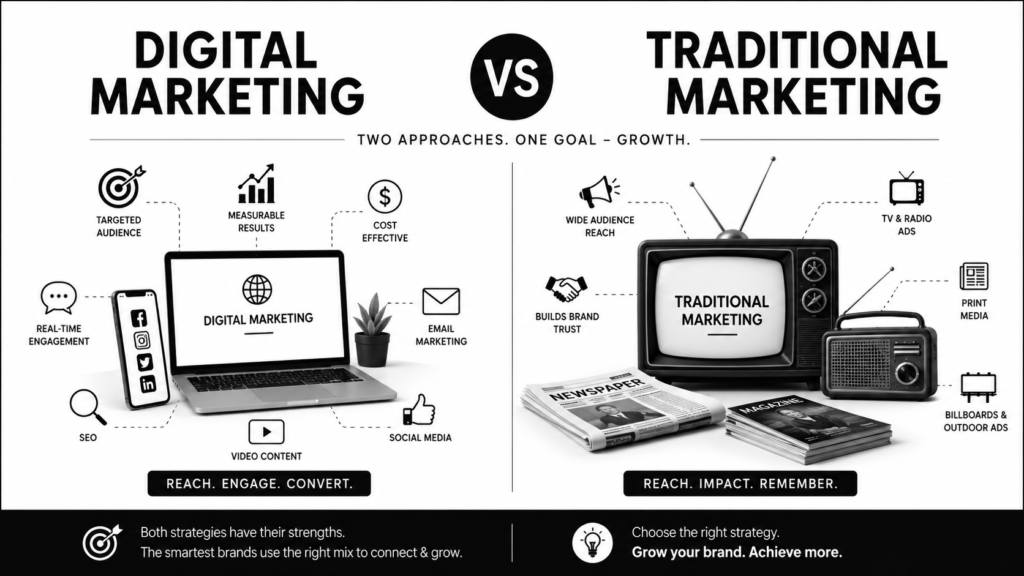
Marketing has always been the key to connecting businesses with customers. However, the way businesses promote their products and services has changed dramatically over the years. While traditional marketing methods such as television, newspapers, radio, and billboards continue to exist, digital marketing has transformed how brands reach and engage their audiences.
So, which approach is better? The answer depends on your business goals, target audience, and budget. Let’s compare both marketing methods to understand their strengths and differences.
Traditional marketing refers to offline promotional methods that have been used for decades. These include television commercials, newspaper advertisements, magazines, radio promotions, flyers, brochures, billboards, and direct mail.
Traditional marketing is highly effective for reaching local audiences and building brand awareness, especially among people who consume offline media. However, it often requires a larger budget and offers limited options for measuring campaign performance.
Advantages of Traditional Marketing
- Builds strong local brand recognition
- Reaches audiences who prefer offline media
- Creates high credibility through established media channels
- Ideal for large-scale brand awareness campaign
Limitations of Traditional Marketing
- Higher advertising costs
- Limited audience targeting
- Difficult to measure return on investment (ROI)
- Campaigns cannot be updated once published
What Is Digital Marketing?
Digital marketing uses online platforms to promote products and services. It includes Search Engine Optimization (SEO), social media marketing, content marketing, email marketing, pay-per-click (PPC) advertising, influencer marketing, and website optimization.
Digital marketing allows businesses to reach customers across the world while tracking every click, impression, and conversion in real time.
Advantages of Digital Marketing
- Cost-effective for businesses of all sizes
- Highly targeted advertising
- Real-time performance tracking
- Easy to optimize campaigns
- Global audience reach
- Better customer engagement through social media and content
Limitations of Digital Marketing
- Requires continuous learning and updates
- High competition in most industries
- Results may take time for strategies like SEOS
- uccess depends on consistent content and optimization
Which Marketing Strategy Is Better?
Neither strategy is universally better than the other. The best choice depends on your business objectives.
If your goal is measurable growth, lead generation, online sales, and reaching a wider audience, digital marketing offers greater flexibility and a higher return on investment.
Traditional marketing remains valuable for businesses targeting local communities or running large-scale awareness campaigns through television, print, or outdoor advertising.
Many successful businesses combine both approaches to maximize their reach and create a consistent brand experience.
Final Thoughts
The marketing landscape continues to evolve, and businesses that adapt to changing customer behavior gain a competitive advantage. Digital marketing offers speed, measurable results, and targeted communication, while traditional marketing continues to build trust and broad visibility.
The most successful brands understand when to use each strategy and how to integrate them effectively.
CTA
🚀 Ready to grow your business with a results-driven marketing strategy?
Whether you’re launching a new brand or looking to expand your online presence, the right digital marketing approach can help you reach more customers, generate quality leads, and increase sales.